
If you’re a homeowner in Naples or thinking about establishing Florida as your permanent residence, understanding the Florida Homestead Exemption is essential. This benefit offers immediate tax savings and long-term protection against rising assessments, making it one of the most important tax advantages available to Florida property owners.
Because questions about Homestead, residency, deadlines, portability, and potential disqualifiers come up so often, I’ve created a clear, comprehensive guide you can rely on as the 2025-2026 deadlines approach.
Who Qualifies for the Florida Homestead Exemption?
Florida’s qualification rules are simpler than most people realize. Contrary to a persistent myth, you do not need to live in your Florida home six months a year.
The real requirement:
➡️ Your Florida property must be your permanent residence, your true home base.
Florida determines this through intent, supported by objective indicators such as:
- Florida driver’s license or ID
- Florida vehicle registration
- Florida voter registration
- Declaration of Domicile
- Florida address used for tax filings
- Where you return after travel
- Not claiming primary residence benefits in another state
Florida does not use a day-count test for Homestead eligibility.
If You Spend More Than Six Months Somewhere Else
Many homeowners split time between Florida and another state, and that’s perfectly fine.
Spending more than half the year somewhere else does not disqualify you
…as long as your Florida home is your permanent residence and you do not claim residency-based property exemptions in another state.
What will cause problems:
Claiming any of the following outside Florida:
- New York STAR
- Michigan PRE
- Ohio Owner-Occupancy Credit
- Any non-Florida Homestead or Primary Residence benefit
It’s the conflict in declared residency, not time spent, that causes issues.
The January 1 Ownership & Occupancy Requirement
Eligibility for any tax year in Florida requires that you own and occupy the home as your permanent residence on January 1 of that tax year.
Example 1: Purchased in June 2025
You did not own and occupy the home on January 1, 2025, so you are not eligible for the 2025 tax-year exemption.
Your first opportunity to file is for the 2026 tax year, with a deadline of:
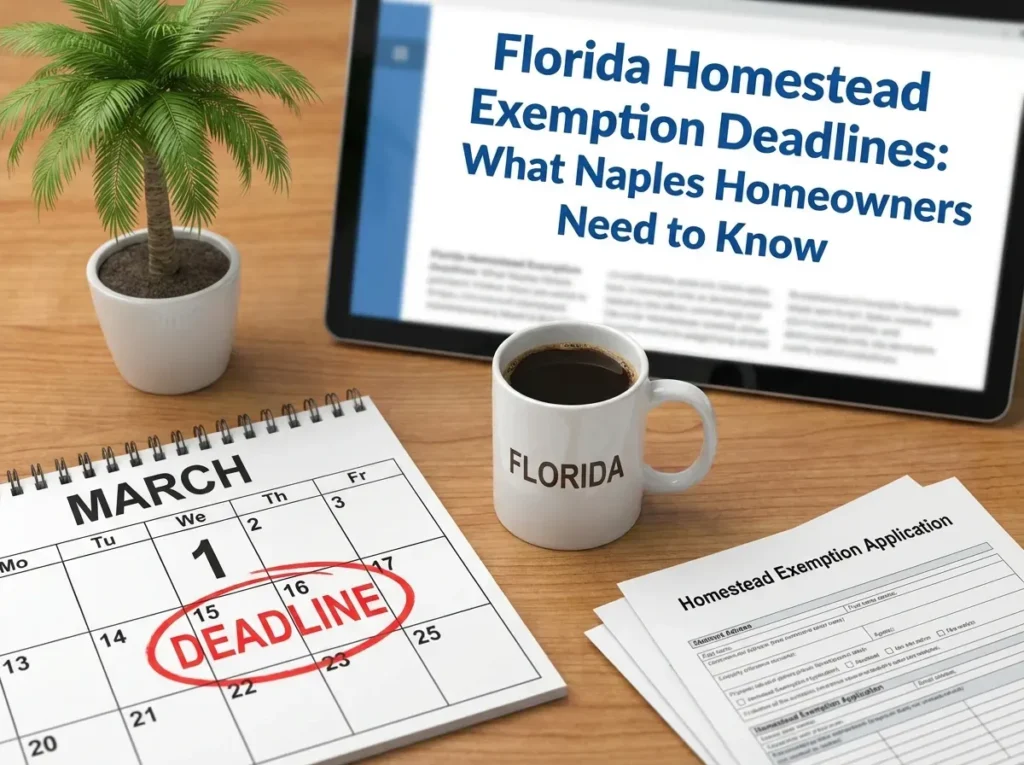
➡️ March 1, 2026
Example 2: Purchased in December 2025 (and moved in by Jan 1, 2025)
If you own and occupy the home on January 1, 2025, you meet the requirement for the 2025 tax year.
Your filing deadline is:
➡️ March 1, 2025
Many counties encourage new residents to “establish residency by December 31” because:
- You need your Florida driver’s license showing the new address before 1/1.
- You need voter registration
- You need other documents updated
- The home must be occupied as permanent residence by January 1
So December 31 is a best-practice cutoff, not a legal filing deadline. But the actual Homestead filing deadline is always March 1.
Automatic Renewal
Your exemption renews each year unless you:
- Sell the property
- Move to another residence
- Change title
- Claim residency elsewhere
- Begin renting out the home
Save Our Homes Portability: A Major Florida Tax Advantage
The Save Our Homes cap limits increases in assessed value to 3% or inflation each year. Over time, this creates a substantial gap between your assessed and market values, a benefit you may transfer to a new Florida home.
Portability Highlights
- Transfer up to $500,000 in SOH savings
- Must file portability within 3 years of abandoning the prior Homestead
- Must apply by March 1
For many homeowners moving into the Naples market, portability dramatically reduces the tax burden on a new home.
Common Disqualifiers for Florida Homestead
Florida actively audits Homestead claims. The most common issues include:
1. Renting Out the Entire Home
Renting the property for more than 30 days per year in consecutive years may signal abandonment of permanent residence.
2. Claiming Residency Benefits in Another State
This is the #1 cause of Homestead revocation.
3. Title Changes
Marriage, divorce, trusts, estate planning, or adding/removing owners may impact eligibility.
4. Using the Home as an Investment Property
If income generation becomes the primary purpose, the exemption may be denied.
5. Residency Inconsistencies
Conflicting IDs, vehicle registrations, tax documents, or voting records can lead to denial or audits.
Where to Apply for Homestead Exemption
📍 Collier County (Naples, Marco Island, Immokalee)
Collier County Property Appraiser
➡️ Website: https://www.collierappraiser.com
Collier County does not currently have an online option. New applications for Homestead Exemption for the current year must be made in person prior to March 1st.
➡️ Phone: (239) 252-8141
📍 Lee County (Fort Myers, Bonita Springs, Estero, Cape Coral)
Lee County Property Appraiser
➡️ Website https://www.leepa.org
Online filing is an option in Lee County and can make it more efficient.
➡️ Phone: (239) 533-6100
Why the Homestead Exemption Matters, Especially in Naples
Naples remains one of Florida’s strongest appreciation markets. That means the combination of:
- Annual tax savings
- Save Our Homes protection
- Portability between Florida homes
…can provide long-term financial advantages, particularly in high-demand neighborhoods such as Park Shore, Olde Naples, Aqualane Shores, Moorings, Coquina Sands, Pelican Bay, and the Isles of Collier Preserve.
What You Need When Filing
Be ready with:
- Proof of ownership
- Florida driver’s license or ID with your property address
- Florida vehicle registration
- Florida voter registration
- Declaration of Domicile (recommended)
- Social Security numbers for all owners/spouses
Important Disclaimer
This article is intended as a helpful overview based on commonly asked questions, but it is not legal, tax, or accounting advice.For the most accurate and up-to-date information regarding eligibility, deadlines, portability, and residency requirements, you should contact the Property Appraiser’s Office in the county where your home is located or consult with a qualified legal or tax professional. Every homeowner’s situation is unique, and the county appraiser is always the final authority.
Frequently Asked Questions
When is the Florida homestead exemption deadline?
You must own and live in the home as your permanent residence on January 1, and file with the county property appraiser by March 1.
What is homestead portability?
It lets you transfer some of your Save Our Homes savings from a previous Florida homestead to a new one.
Can I lose my homestead exemption?
Yes. Renting the home or claiming residency elsewhere can disqualify it, so check the rules before making changes.
Related reading: Florida Homestead Portability and Property tax savings… don’t forget to homestead
If you are considering buying or selling a home in Naples and surrounding areas and you aren’t satisified with average services, you will want to contact Your Naples Real Estate Expert, Renee Hahn, to ensure you get the service, attention and outcomes you deserve.
Renee Hahn, Ranked in the top 0.5% to 1.5% in the Nation
📍 Naples, Florida
📞 (239) 287-2576
#️⃣ Instagram: @reneehahnluxurynaples
#️⃣ Facebook: LuxuryRealEstateinNaples
▶️ YouTube Channel: https://www.youtube.com/channel/UC_XYJyAZdOdtkKFgWx-KuVg